
Bottomless Portafilter
A spout hides what your coffee is doing. Take it off and the whole puck stays in view, so you see the jets, the blonding and the first drop on every shot. Stainless steel head, the handle you pick, filter basket included.
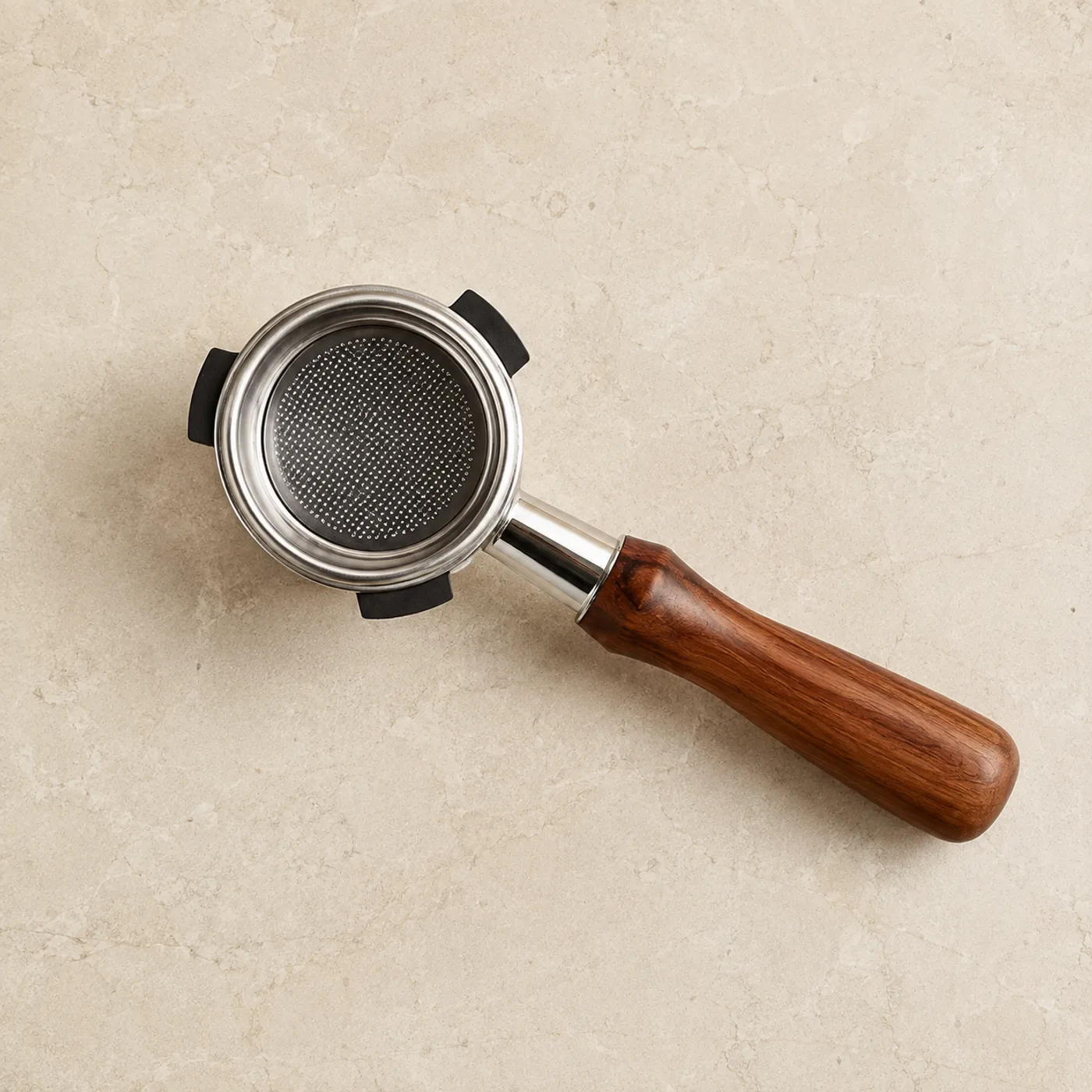
The spout is what keeps you guessing
With a spouted portafilter every shot arrives already mixed. Two streams merge inside the spout and land in the cup, and whatever went wrong upstream has been blended away by the time it reaches you. The shot can taste thin and you still have no way of telling whether the grind was too coarse, the dose too low, or the puck simply cracked on one side.
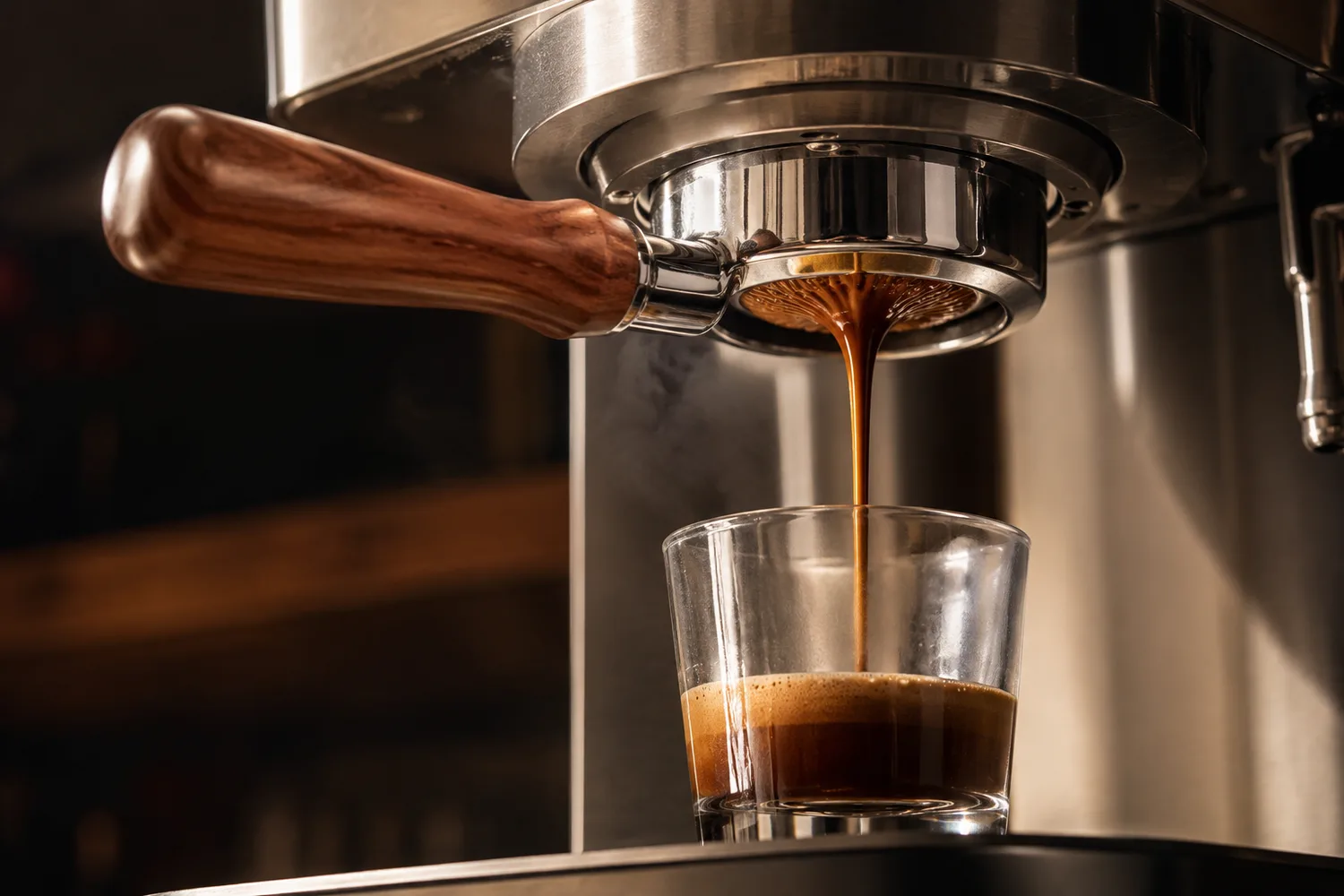
Take the spout off and the guessing stops. A well-prepared puck releases evenly across the whole basket: the flow starts dark and slow, gathers into a single centered stream, then lightens gradually. A badly prepared one announces itself straight away. A thin jet spraying off at an angle means water has found a channel and taken it, usually a low spot in the bed, a clump the distribution missed, or a tamp that leaned. A patch that stays pale while the rest darkens means that part of the puck never got properly wet.
The first drop. On a shot that is roughly in range, liquid appears a handful of seconds after the pump starts, as a single dark bead near the center. Much sooner and the grind is too coarse or the dose too light, because the water is not meeting enough resistance. Much later, with the machine audibly straining, and the grind has gone too fine.
The shape of the stream. What you are looking for is a few droplets that gather into one centered rope, thick and steady. That single rope is the sign that the whole bed is releasing at the same rate. Two or three separate ropes that never merge mean the puck is extracting in patches, and the cup will taste both sour and bitter at once because you are mixing under-extracted and over-extracted coffee.
The side jet. This is the one everybody notices first, and it is why bottomless portafilters have a reputation for making a mess. A thin stream firing sideways, sometimes hard enough to reach the drip tray wall, is channeling. The fix is almost never pressure. It is distribution, dose, or a tamp that was not level.
Blonding. Toward the end of the shot the stream lightens from dark caramel to pale straw. That is the point where most of what you want is already out, and what follows is thin and increasingly bitter. With a spout you guess at it; with an open base you watch it arrive and stop the shot there. A lot of people discover they had been running their shots several seconds too long.
None of this is caused by the portafilter. It was always happening; the spout was simply covering it up. What changes is that the diagnosis arrives in real time, on the shot you are actually pulling, instead of being reconstructed from the taste afterwards. The water, the grind, the dose and the machine do the work, and an open base puts all four in plain view while they do it.
There is a second reason, and buyers raise it about as often as the first: the cup gets cleaner. A spout is a narrow channel that traps oils and old grounds, and it is awkward to reach with a brush. With no spout there is nothing to trap anything. The basket lifts out, the head rinses under the tap, and that is the entire cleaning routine.
Built around the part that matters
An open base, machined flat
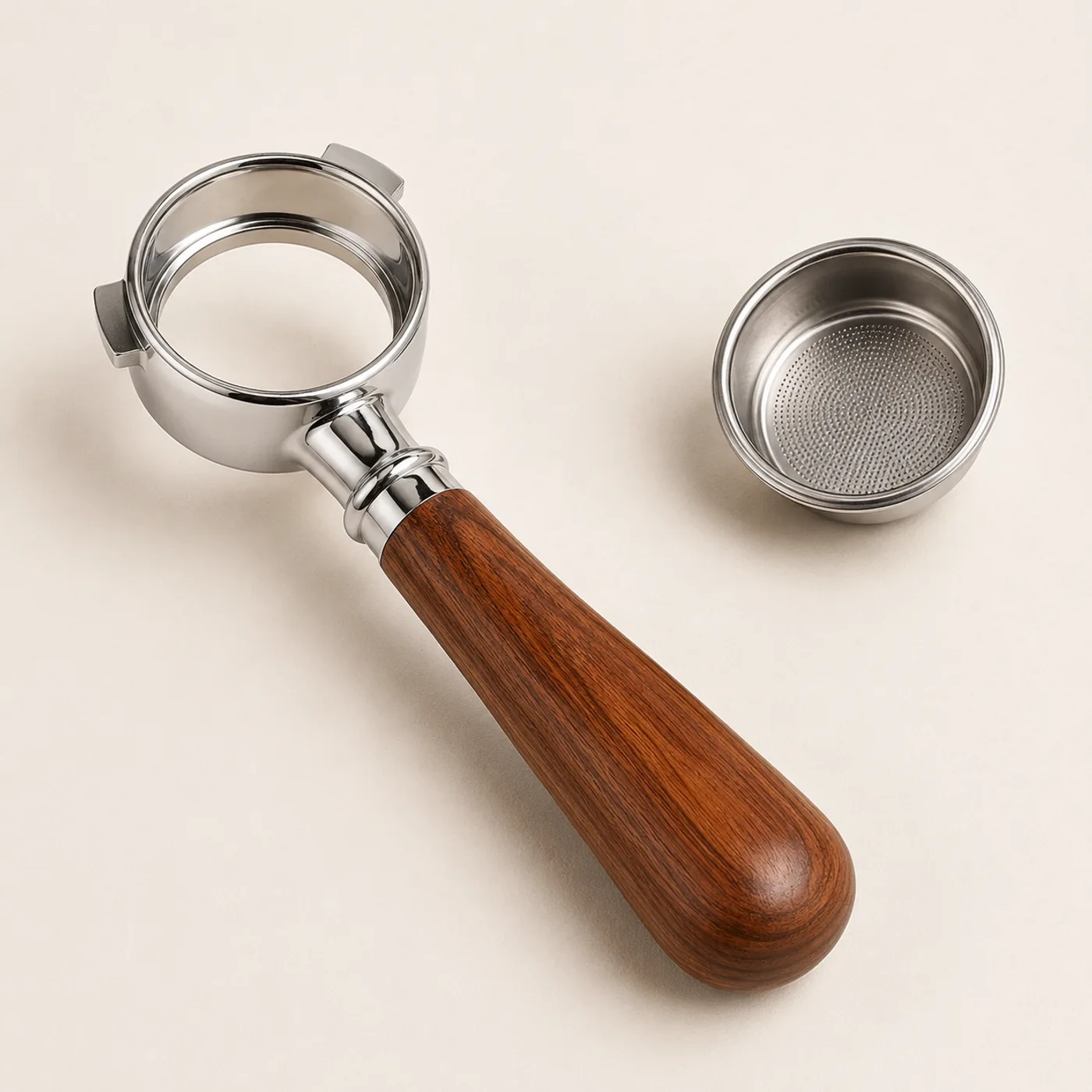
The underside is a single clean opening with no lip and no step, so nothing interrupts the view of the puck or catches the flow on its way out.
The rim that carries the basket is turned flat, which matters more than it sounds. A basket sitting crooked reads as channeling when the real problem is the seat. Here the basket drops in, sits level, and lifts straight back out for rinsing.
Stainless head, wood in the hand
Steel where the heat is, wood where your hand is. The head carries the thermal mass; the handle stays cool enough to hold with bare fingers straight off the group. Three of the four handles are turned hardwood, and the fourth is a moulded black for anyone who prefers it.
The head is stainless steel, so it holds heat through the shot instead of pulling it out of the water. The wood handles are each a single piece of turned hardwood, finished smooth and fitted with a chrome collar and end cap; the black one is moulded and fitted the same way. Rosewood and beech are offered on every fit, and the word buyers reach for most often when they write about the wood is simply the look of the grain.
The basket is in the box
A 2-cup filter basket ships with every portafilter. You are not buying a handle and then discovering that the part which actually holds the coffee costs extra.
It is a non-pressurized basket, the kind with a full field of fine holes rather than a single valve underneath. That is the only sort that works bottomless: a pressurized basket forces the flow through one point by design, so there would be nothing to watch.
The fit table, by machine model number
Portafilter sizing is where most of the confusion lives, and it is not really a question of millimeters. Two machines can both take a 51 mm basket and still need different portafilters, because the lugs that lock into the group head are arranged differently. Each of the four fits below is listed against the model numbers printed on the machines themselves rather than against a diameter alone.
Fit is also what buyers write about most: 104 of the 389 written reviews talk about whether the portafilter fitted their machine — more than talk about the wood, the basket, the price and the delivery put together. If your model appears on the table, the matching fit is the one you want.
| Fit | Machines it locks into | Handle woods |
|---|---|---|
| 54 mm | Breville / Sage BES 450, 820, 840, 870, 875, 876, 878, 879, 880, 881 · Solis 1170 | Rosewood, Beech, Chacate Preto |
| 51 mm — 3 ears | DeLonghi Dedica EC680, EC685 · Dedica Arte EC885 · SMEG · Severin KA5995 · Casabrews 3700 PRO | Rosewood, Beech, Chacate Preto |
| 51 mm — 2 ears | DeLonghi Stilosa EC260 · ECP3420 · EC155 · BCO430 | Rosewood, Beech, Chacate Preto |
| 58 mm | HiBREW H7, H7a, H10a · Breville Barista Max, Mini, Signature · Barsetto | Rosewood, Beech |
What 389 written reviews actually say
of 389 written reviews mention how the portafilter fitted their machine
— Written buyer reviews, 2026
mention build quality, the subject buyers write about most
— Written buyer reviews, 2026
espresso machine models named on the fit table, across four separate fits
— Puckwell compatibility list, 2026
What changes when the spout comes off
| Spouted portafilter | Bottomless portafilter | |
|---|---|---|
| Channeling | Invisible, because the streams merge before you see them | Visible the moment it starts, as a jet leaving the puck at an angle |
| Blonding | Judged from the color in the cup, after the fact | Watched at the basket, so the shot can be stopped on time |
| Cleaning | Oils collect inside the spout, which is hard to reach | Nothing to trap oils: rinse the head, lift the basket out |
| Splashing | Hidden by the spout, along with its cause | Visible for a few days, then gone for good |
| Two cups at once | Two half streams, split before you can read either one | One full stream you pour into two cups |
The splashing has a simple explanation. A bottomless portafilter will spray while your grind and distribution are still settling, because it is showing you a problem the spout used to hide. That phase is short, and it is the whole point: once the jets stop they stop for good, and you know why.
It is also the reason the fit matters so much. A portafilter that sits even slightly proud in the group head will leak around the gasket and read as a puck problem when it is nothing of the kind, which is why 83 of the 389 written reviews use the word “fits” and 57 use “perfectly”. Get the fit right first, then read the shot.
“The first week with a naked portafilter is humbling, and then it becomes the most useful feedback loop in the kitchen. You stop adjusting the grinder on a hunch, because the shot tells you where the water went.”— Dana Whitlock, espresso guides editor, Puckwell
Everything else worth knowing
How to choose your fit, and what the first week looks like
Start with your machine, not with the millimeters. Find your model on the fit table above. If you own a Breville or Sage Barista Express, Pro, Touch, Infuser, Bambino or Duo-Temp, you want the 54 mm. If you own a DeLonghi, count the lugs on the portafilter you already have: the Dedica family uses three, the Stilosa family uses two, and they are not interchangeable even though both take a 51 mm basket. If your machine takes a 58 mm portafilter, check the model list rather than the number. 58 mm is a shared diameter, not a shared fitting, and a portafilter built for one 58 mm group head will not necessarily lock into another.
Then choose the wood. Rosewood is a warm red-brown, beech is a pale honey, and the dark option is a deep chocolate grain on the 51 and 54 mm fits. The 58 mm comes from a different mold, with a facetted collar and a more conical handle, and is offered in rosewood and beech. The timber is the same; it is the shape of the handle that changes, and you would notice it in your hand.
What the first week looks like. Expect spray. Almost everyone gets it, and it is not a fault in the portafilter. It is the first clear view of a puck that was never quite level. Grind a little finer, break up the clumps before you tamp, and keep the tamp flat rather than hard. The jets usually settle within a handful of shots. If one corner keeps firing, the culprit is nearly always distribution rather than pressure, and the cheapest fix is stirring the grounds in the basket with a fine needle before leveling them.
A note on baskets. The basket in the box is non-pressurized, which is what a bottomless portafilter needs. If you have been using the pressurized basket that came with your machine, the one with a single small hole underneath, it will not give you anything to watch: it forces all the flow through one point by design. Swap it for the basket included and the difference is immediate. It also means your grind will need to change, because a pressurized basket compensates for a coarse grind and a non-pressurized one does not.
Keeping it clean. Rinse the head and the basket under hot water after each session and wipe the steel dry. Once a week, take the basket out and check the underside of the rim where fines collect. Keep the wooden handle out of the dishwasher and do not leave it soaking: heat and prolonged water are what lift the finish on turned hardwood. Detergent tablets meant for group heads are fine on the steel and should stay away from the wood.
Specifications
| Head material | Stainless steel |
| Handle | Turned hardwood or moulded black, chrome collar and end cap |
| Fits | 51 mm (2 ears), 51 mm (3 ears), 54 mm, 58 mm |
| Basket | 2-cup non-pressurized filter basket, included |
| Handle woods | Rosewood, Beech, Chacate Preto on 51 and 54 mm · Rosewood, Beech on 58 mm |
| Care | Rinse the head and basket under hot water; keep the wood out of the dishwasher |
Wood is a natural material, so grain and shade vary from one handle to the next. The photographs show representative pieces rather than the exact handle you will receive.
Rated 4.9 / 5 across 382 verified buyers
"Perfect fit for the delonghi stilosa ec260 (51 mm 2-ear option). The basket easily fits 18 grams of coffee. Wood is mate and feels nice."
— Dominic H., verified buyer
"Very nice quality and fits perfectly in sage bambino. feels solid as it has double the weight of the original portafilter."
— Marcus T., verified buyer
"Very good quality. Comes with a basket of 16-18 grams. On the Hibrew A10 it fits perfectly. I have swapped the handle and it fits perfectly. Very fast delivery."
— Tomas V., verified buyer
More buyer photographs on our reviews page.
Bottomless portafilter questions
Why is my bottomless portafilter spraying everywhere?
Spray means water has found a channel through the puck and taken it instead of soaking through evenly. It is almost always puck prep rather than the portafilter: clumps left in the basket, a dose too low for the basket, or a tamp that went in at a slight angle. Break the clumps up, level the bed before tamping, and keep the tamp flat rather than heavy. If one spot keeps firing in the same place every shot, check the basket is seating flat.
Does a bottomless portafilter actually make better espresso?
It does not change the coffee by itself. It changes what you can see. The extraction faults it reveals were already happening behind the spout. What improves is your ability to correct them, because the feedback arrives on the shot you are pulling rather than from the taste afterwards.
Which size portafilter does my machine take?
Look your model number up on the fit table above rather than measuring. Breville and Sage Barista machines take 54 mm. DeLonghi Dedica machines take 51 mm with three lugs; DeLonghi Stilosa machines take 51 mm with two. HiBREW, Barsetto and the larger Breville machines take 58 mm. If your model is not listed, send us the number and we will check it for you.
Is a filter basket included?
Yes. Every portafilter ships with a 2-cup non-pressurized filter basket. That is the type a bottomless portafilter needs, because a pressurized basket forces all the flow through a single hole and there would be nothing to see.
Can I still pull two separate cups?
Not into two cups at the same time, because there is no spout to split the stream. Most people brew into one vessel and divide it, or pull two shots. If you make two coffees at the same time every morning, brewing into one vessel and dividing it is the routine most people settle on.
How do I clean it?
Lift the basket out, rinse both parts under hot water, and wipe the head dry. There is no spout to trap oils, which is why cleaning is quicker than with a standard portafilter. Once a week, check the underside of the rim where fines gather. Keep the wooden handle out of the dishwasher and away from prolonged soaking.
Will the handle get hot?
The stainless head carries the heat, and wood does not conduct it the way metal does, so the handle stays comfortable to hold with bare fingers. The head itself will be hot after a shot, as any portafilter is.
What if it does not fit my machine?
Returns are free within 30 days. If your model is not on the fit table, send us the model number before ordering and we will tell you whether one of the four fits matches. That is quicker and surer than guessing from a diameter.
See what your coffee has been doing
Four fits, three woods each, filter basket in the box. Free shipping and 30 days to change your mind.
Choose your fit →